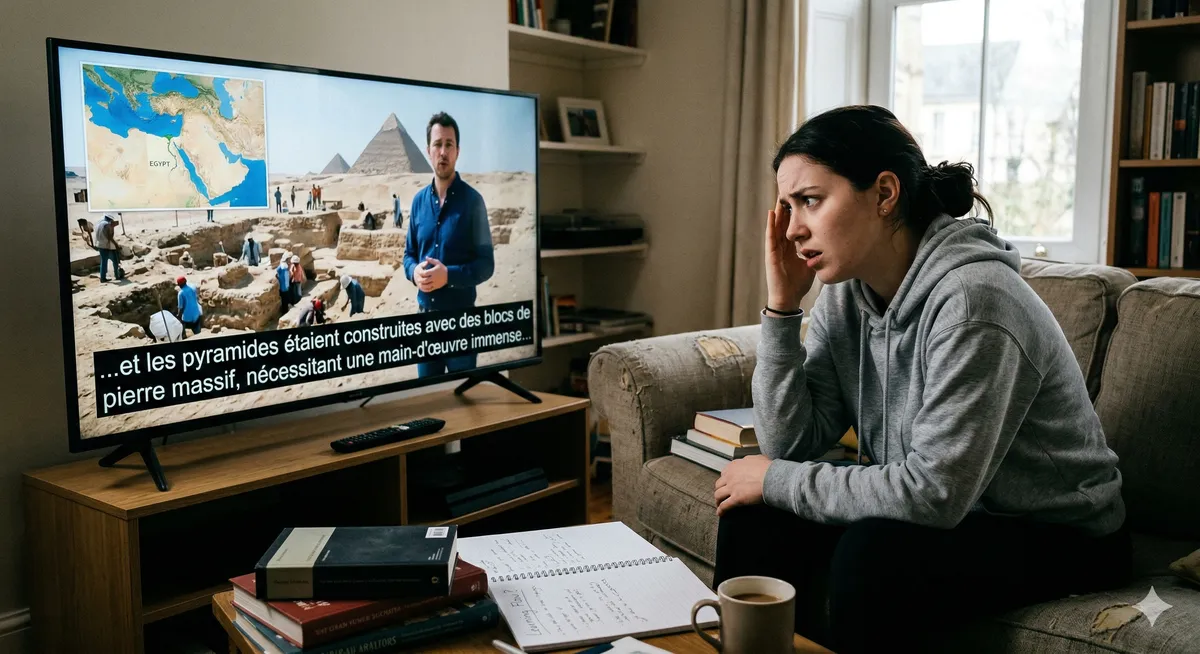
We've been trained to think subtitles are the solution to language barriers in video. But if you've ever tried to follow a 40-minute lecture with subtitles, you already know: it's exhausting. Your eyes jump between the content and the text. You miss diagrams. You lose track of what was said three seconds ago.
Subtitles were designed for a world where text was the only option. That world no longer exists.
What happens in your brain when you read subtitles
Every time a new line of text appears at the bottom of the screen, your brain has to do three things at once: read the words, process the meaning, and try to follow the visuals. Cognitive psychologists call this split-attention effect — and it's one of the most studied barriers to effective learning.
Studies on multimedia learning consistently show that when text and visuals compete for attention, retention drops significantly. The brain isn't multitasking — it's rapidly switching, and each switch has a cost. Over a 30-minute video, those micro-costs add up to a major gap in comprehension.
Here's what this looks like in practice:
- You miss visual cues — a chart, a code snippet, a facial expression — while your eyes are locked on the subtitle bar
- You can't take notes because the moment you look away, the subtitle is gone
- Your eyes fatigue faster — constant vertical scanning between content and text is physically tiring
- You retain less overall — the effort of reading displaces the effort of understanding
- You lose context — complex arguments require sustained attention, not constant interruption
The result? You finish the video feeling like you watched it, but you can't explain what you actually learned.
The real cost: time and motivation
Imagine a developer in São Paulo trying to follow a React tutorial from a Japanese creator. With subtitles, a 20-minute video easily becomes 35 minutes — pausing, re-reading, rewinding. Multiply that across a full course with 30 lessons, and you've lost hours just to the overhead of reading.
But the biggest cost isn't time. It's motivation. When every video feels like effort, people stop watching. They stick to content in their own language, even when the best material exists elsewhere. The barrier isn't access — it's friction.
The best tutorial in the world is useless if it's too exhausting to follow.
Why listening works better for learning
When you listen to content in your own language, something fundamentally different happens. Your brain processes speech through a channel that has been optimized since childhood. You don't have to decode — you simply understand.
This frees your visual attention entirely. You can watch the screen, follow a demo, read code, study a diagram — all while absorbing the explanation through audio. It's how learning works in a classroom, in a conversation, in a podcast. It's the natural mode.
Research on dual-coding theory supports this: learning improves when verbal and visual information arrive through separate channels rather than competing in the same one. Audio in your language + visuals on screen = the ideal combination for retention.
What Vaivox does differently
Instead of overlaying subtitles, Vaivox translates the entire audio track into your language using AI voices. The result feels natural — as if the creator was speaking your language from the start.
But translated audio is only the first layer. Vaivox also generates:
- A full translated transcript you can search, highlight, and reference later — perfect for review
- A structured AI summary with the key points extracted — so you can decide if a video is worth your time before committing
- An audio summary you can listen to on the go — ideal for revision while commuting or exercising
This means you get three ways to interact with every video: listen deeply, read at your pace, or skim the essentials. Subtitles only give you one — and it's the most tiring option.
When subtitles still make sense
Subtitles aren't bad in every context. They work well for short clips, music videos, movie scenes, or casual social media content where the visual is simple and the text is minimal.
But for serious learning — courses, tutorials, lectures, conference talks, technical deep-dives — subtitles create more friction than they solve. The longer the video, the higher the cost.
A simple test
Next time you watch a subtitled video longer than 10 minutes, ask yourself: how much of this could I explain to someone right now? If the answer is vague, it's not because the content was bad. It's because your brain spent more energy reading than learning.
The future of multilingual video isn't reading. It's listening. And that future is already here.